
So, which embroidery product is right for you? We’ve put together this comparison to help guide you to the right solution.
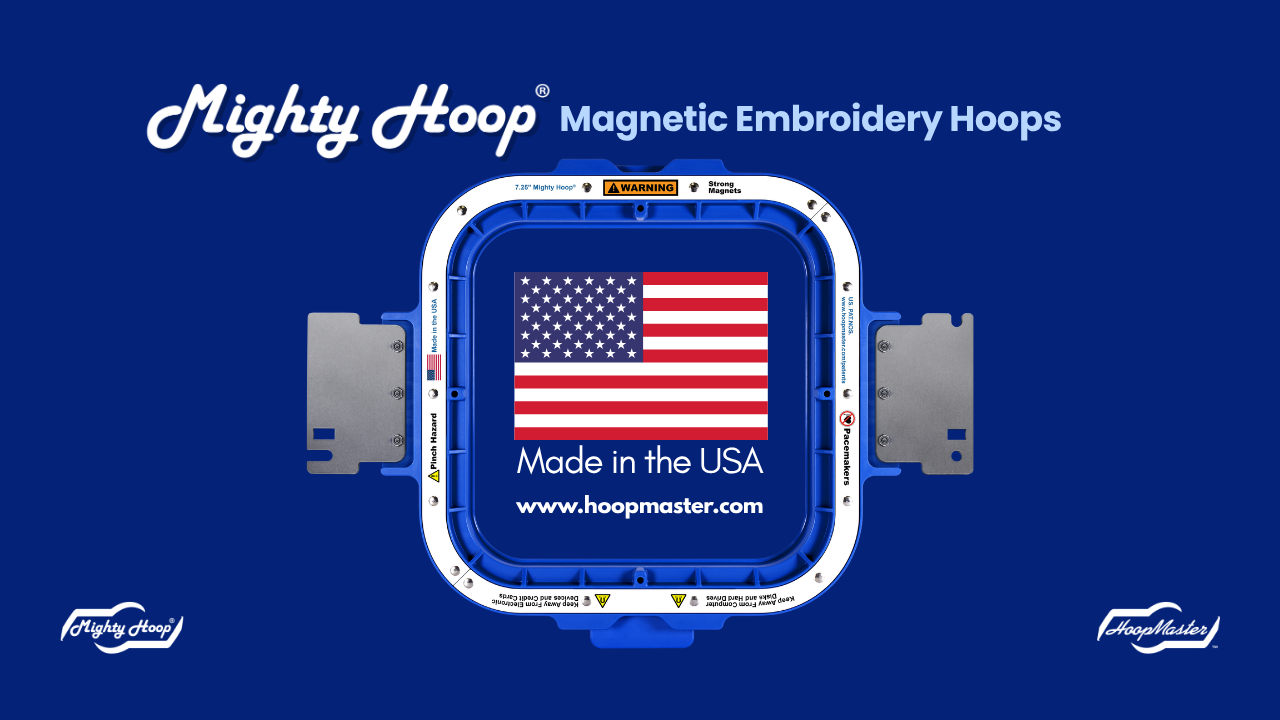
Mighty Hoop vs. MaggieFrame: U.S. Patents, Sewtech, SewTalent, MaggieFrame, and Magnetic Embroidery Hoops Explained
November 7, 20260
If you are researching MaggieFrame vs. Mighty Hoop, Maggie hoops vs. Mighty Hoops, Sewtech magnetic hoops, or SewTalent magnetic hoops, one of the most important differences to understand involves U.S. patent rights.
Mighty Hoop® and HoopMaster® products were developed by Midwest Products, Inc. after years of hands-on experience in the commercial embroidery industry. The technology incorporated into these products is protected by multiple U.S. utility patents owned by Midwest Products.
Midwest Products has determined that certain magnetic embroidery hoops and related hooping products marketed under names including MaggieFrame, Maggie Frames, SewTalent, Magnetic Hoop, MagneticHoop.com, and related brands infringe claims of our U.S. patents.
Midwest Products actively protects and enforces these patent rights.
We receive many questions about MaggieFrame, Sewtech, SewTalent, and similar magnetic embroidery hoops. We also see a great deal of confusion about what patents protect, whether changing a product’s color or name matters, whether a foreign patent makes a product legal in the United States, and whether a product manufactured in China is subject to U.S. patent law.
The purpose of this article is to educate.
Patent and intellectual-property law can be difficult to understand, particularly when products are sold directly from overseas and promoted heavily through social media. Many customers and creators may have no reason to know that a product raises patent concerns.
Our goal is to explain our position and the basic principles involved so customers, creators, affiliates, dealers, and embroidery businesses can make informed decisions.
Quick Answer: What Is the Patent Issue Between MaggieFrame and Mighty Hoop?
Midwest Products owns multiple U.S. utility patents covering technology used in Mighty Hoop magnetic embroidery hoops and related HoopMaster hooping products.
Midwest Products’ position, based on our patent analysis, is that certain MaggieFrame magnetic embroidery hoops and related products use technology covered by claims of those patents.
This is not simply an issue of two hoops looking similar.
Utility patents protect inventions as defined by their patent claims, including functional technology. Changing a product’s color, brand name, website, packaging, or other cosmetic features does not by itself avoid patent infringement if the product continues to practice all the elements of a valid patent claim.
That distinction is important when comparing MaggieFrame vs. Mighty Hoop.
Are Mighty Hoops Patented?
Yes.
Midwest Products owns multiple U.S. utility patents covering technology used in Mighty Hoop and HoopMaster products, including:
- U.S. Patent No. 7,607,399
- U.S. Patent No. 7,918,169
- U.S. Patent No. 7,966,957
- U.S. Patent No. 8,584,606
- U.S. Patent No. 8,661,995
Customers can review information about our patents on the HoopMaster website and through public U.S. patent records. https://hoopmaster.com/patents
These are utility patents, which is important because utility patents concern functional inventions and technology rather than simply a product’s brand name, color, logo, or overall appearance.
What Does a Utility Patent Protect?
One common misunderstanding is that a patent protects only what a product looks like.
That is not how a utility patent works.
A utility patent protects an invention as defined by the claims of the patent. Those claims can cover functional technology, components, combinations, and how an invention operates.
That is different from a trademark, which identifies the source or brand of a product, and different from rights that may protect ornamental appearance.
This is why simply changing:
- green plastic to blue plastic;
- a product name;
- a company name;
- a logo;
- packaging;
- a website; or
- other cosmetic details
does not by itself avoid infringement of a utility patent.
The relevant question is whether the product still practices every element of an applicable patent claim.
For that reason, the patent issue surrounding MaggieFrame is not about whether a magnetic hoop is green, blue, white, or another color. It is about the technology used in the product.
Do MaggieFrame Magnetic Hoops Infringe Mighty Hoop Patents?
Midwest Products’ position is that certain MaggieFrame magnetic embroidery hoops and related products infringe multiple claims of one or more of our U.S. patents.
The issue is not simply that the products perform a similar job or have a similar appearance.
Patent infringement is evaluated against the claims of the patent.
Changing a product from MaggieFrame to SewTalent, Magnetic Hoop, or another brand name does not resolve a patent issue if the underlying product continues to use technology covered by an active patent claim.
What Are MaggieFrame, Sewtech, SewTalent and Magnetic Hoop?
Products connected with the same China-based company have been marketed under a number of names, websites, and brands, including:
- MaggieFrame
- Maggie Frames
- Sewtech
- SewTalent
- Sew Talent
- Magnetic Hoop
- MagneticHoop.com
Other names, websites, colors, and branding may also be used.
Consumers should understand that changing a brand name or website does not change the patent analysis of the underlying product.
Midwest Products has determined that certain MaggieFrame magnetic embroidery hoops and related magnetic hooping products infringe claims of U.S. patents covering technology used in Mighty Hoop and HoopMaster products.
Does MaggieFrame Have a Patent?
You may see MaggieFrame, Sewtech, SewTalent, or a related company state that it has patents of its own, including patents issued in China.
That does not resolve the U.S. patent issue.
Patent rights are territorial. A patent issued in China provides rights under Chinese law. It does not automatically provide patent rights in the United States, and it does not override an active U.S. patent.
Likewise, a U.S. patent provides rights in the United States and does not automatically create patent rights in another country.
Most importantly, having a patent does not automatically give the patent holder permission to manufacture or sell everything incorporated into its product.
A company can receive a patent on a particular improvement, modification, feature, or narrower invention while the resulting product still uses technology covered by an earlier patent owned by someone else.
In other words:
Having your own patent does not automatically give you freedom to practice another company’s patented invention.
Does a Chinese Patent Make MaggieFrame Legal in the United States?
No. A Chinese patent does not by itself create U.S. patent rights or determine whether a product infringes a U.S. patent.
A foreign patent also should not be interpreted as proof that every feature of the product is new, unique, independently developed, or free from earlier patent rights.
A patent may cover only a specific feature or improvement.
Even if a company has received a patent concerning some aspect of its own product, that does not necessarily mean the entire product is original technology, nor does it establish that making, importing, selling, or using the complete product will not infringe someone else’s earlier patent.
This principle can apply even when both patents are U.S. patents. A later patent on an improvement does not necessarily give its owner the unrestricted right to practice technology covered by an earlier patent.
A patent generally gives its owner the right to exclude others. It does not automatically give the patent holder an affirmative right to make, use, sell, offer for sale, or import a product if doing so would violate another party’s earlier patent rights.
Therefore, if a China-based company says, “We have a patent,” customers should not assume that means:
- the product is patented in the United States;
- the product does not infringe Midwest Products’ U.S. patents;
- the entire product is a new or independently originated invention;
- the company has permission to use technology covered by Midwest Products’ patents; or
- the product is automatically lawful to import, sell, or use in the United States.
Those are separate legal questions.
Midwest Products’ position remains that the MaggieFrame and related magnetic embroidery hoop products at issue use technology covered by claims of our U.S. patents.
Are Chinese Embroidery Products Illegal?
Absolutely not.
We want to make this distinction very clear.
Midwest Products does not have a problem with products simply because they are manufactured in China.
Many legitimate embroidery machines, accessories, electronics, tools, supplies, and other products are manufactured in China.
The country where a product is manufactured is not the issue.
The issue is whether a product uses technology protected by an active patent in the country where the product is being imported, sold, offered for sale, or used.
There is an important difference between a Chinese manufacturer developing its own lawful competing product and a manufacturer using technology that is still protected by another company’s active U.S. patents.
We believe in fair competition.
A company developing its own lawful product at a lower price is competition.
Copying technology protected by active patents is a different issue.
Does Manufacturing a Magnetic Hoop in China Avoid U.S. Patent Law?
No.
Manufacturing a product outside the United States does not create an exception to U.S. patent law when activities covered by U.S. patent law occur within the United States.
Under 35 U.S.C. §271(a), making, using, offering to sell, or selling a patented invention within the United States, or importing it into the United States, without authority during the patent term can constitute infringement.
Link to the USPTO.GOV and the main site
That means an overseas manufacturer cannot simply manufacture a product in another country and assume U.S. patent rights no longer matter when the product is imported or sold into the United States.
Customers should therefore not assume that a product is lawful in the United States simply because an overseas website is willing to ship it here.
Does Direct Shipping From China Change the Patent Issue??
One question customers should consider is why products promoted so heavily to U.S. embroiderers through social media are generally shipped individually from China rather than being routinely stocked by established U.S. embroidery suppliers.
Midwest Products previously addressed a U.S. distribution arrangement involving products we identified as infringing our patents.
After our patent rights were brought to the attention of the parties involved and reviewed, that U.S. distribution arrangement stopped handling the products.
Midwest Products has observed MaggieFrame products being marketed to U.S. customers through direct overseas sales and individual shipments.
Shipping products one customer order at a time also makes enforcement much more complicated than when large quantities are imported into a centralized U.S. warehouse and distributed domestically.
Individual shipments do not change the underlying patent analysis, it just makes it harder to stop.
Why Don’t Established U.S. Embroidery Dealers Commonly Stock MaggieFrame Hoops?
Despite the amount of MaggieFrame advertising visible on U.S. social media, Midwest Products is not aware of an established U.S. embroidery-machine or embroidery-supply dealer openly stocking and distributing MaggieFrame magnetic hoops through a normal U.S. warehouse and dealer network.
That is not because the embroidery industry is unaware of the products.
Over the years, U.S. businesses have considered or attempted to sell products that Midwest Products identified as infringing our patents.
When we become aware of those situations, we provide information regarding our patent rights.
In multiple situations, the businesses involved have chosen to stop distributing the products after receiving that information.
This is an important part of patent enforcement that consumers may never see.
Not every patent matter requires a federal lawsuit. Often, a company receives notice of the patent rights, reviews the issue with its own attorneys, and makes a business decision based on that information.
Does Midwest Products Actively Defend Its Patents?
Yes.
Midwest Products actively monitors, protects, and enforces its U.S. patent rights.
Midwest Products and members of our team monitor social media, online advertising, websites, affiliate activity, and other public promotion for products that we believe infringe our patents.
When we become aware of a creator, affiliate, business, reseller, or other individual promoting or linking to a product we have determined infringes one or more of Midwest’s patents, we may contact that person directly and provide information about our patent rights and the infringement concerns involved.
Our preference is to educate first.
We understand that many people promoting these products may initially have no idea that there is a patent issue, particularly when an overseas company presents the product as simply another magnetic hoop option.
However, once someone has been specifically notified of Midwest Products’ patent rights, continuing to promote, recommend, advertise, or provide purchase links to products we have identified as infringing becomes a much more serious concern.
A notice from Midwest Products should not be viewed as merely informational, especially if the activity continues.
If an individual or business continues promoting or directing customers to infringing products after being informed of our patent rights, there is a very real possibility that Midwest Products will take further steps to actively enforce those rights when necessary.
Our enforcement efforts may include contacting:
- importers;
- distributors;
- dealers;
- sellers;
- businesses;
- advertisers;
- affiliates;
- creators; and
- other parties involved in promoting or distributing products that we believe infringe our patents.
When necessary, those enforcement efforts may include legal action.
Patent protection represents a significant investment in invention, engineering, testing, tooling, manufacturing, and legal protection. Those rights have little practical value if the patent owner is unwilling to enforce them.
Legal enforcement is not our first choice. We would much rather resolve these situations by providing accurate information and giving people an opportunity to stop the activity once they understand the issue.
However, when someone knowingly continues promoting, selling, linking to, or otherwise encouraging infringement involving products we believe infringe our patents after receiving notice, enforcement may become necessary to protect Midwest Products, our patented technology, and the value of our U.S. patent rights.
Our prior federal patent lawsuit demonstrates that Midwest Products is prepared to enforce those rights when circumstances require it.
At the same time, education remains our preferred first step whenever possible.
What Happened in Midwest Products’ Federal Patent Lawsuit?
There has been misinformation online about a prior federal patent case involving Midwest Products.
On June 25, 2025, Midwest Products filed a federal patent case against Blue Line Crafts LLC and Robert D. Hutchinson, Jr. in the U.S. District Court for the Northern District of Ohio.
The federal docket identifies the matter as a patent case and later reflects that the parties reached a settlement agreement.
The lawsuit was not against the China-based MaggieFrame manufacturer.
It was also not simply a copyright case.
It involved a U.S. party associated with MaggieFrame products and allegations involving Midwest Products’ patent rights.
The matter was resolved through a settlement that Midwest Products considers favorable. As is common with settlements, not every term can be disclosed publicly.
The settlement included a retraction from the defendant correcting multiple claims about Midwest Products’ patent rights, along with other terms Midwest Products considers favorable. Here is the retraction statement.
We specifically wanted the ability to share that retraction because incorrect statements about our patent rights had been circulated publicly.
What Does “Dismissed With Prejudice” Mean?
A federal case ending through settlement and being dismissed with prejudice should not be interpreted to mean that the court determined Midwest Products’ patents were invalid or unenforceable.
That was not what occurred in this case.
A dismissal with prejudice generally means that the claims that were or could have been resolved in that case cannot simply be brought again against the same party or others legally bound by the judgment.
It does not, by itself, mean:
- the patents were cancelled;
- the patents were declared invalid;
- the patents became generally unenforceable;
- the defendant received any ownership over patented technology; or
- the defendant received permanent permission to engage in future infringement.
The settlement and dismissal resolved the claims involving the past conduct addressed in that case.
If the same party were to engage in new acts of infringement after the settlement and dismissal, those new acts could create new legal claims, subject to the specific terms of the settlement agreement.
In other words, a dismissal with prejudice prevents the same resolved claims based on the same past conduct from simply being litigated again. It does not, by itself, provide a permanent exemption from U.S. patent law or a continuing right to use Midwest Products’ patented technology.
The court did not issue a ruling invalidating Midwest Products’ patents.
Midwest Products continues to own multiple active U.S. patents protecting Mighty Hoop and HoopMaster technology, and those patent rights were not invalidated by the dismissal of this case.
That distinction is important because the phrase “dismissed with prejudice” has sometimes been incorrectly presented online as evidence that Midwest Products lost its patents or that the patents are no longer valid.
That is not what a dismissal with prejudice means, and that is not what occurred in this case.
Can Promoting MaggieFrame Create Patent-Infringement Concerns?
It can, depending on the circumstances.
U.S. patent law does not apply only to the company manufacturing an infringing product.
35 U.S.C. §271(b) also addresses actively inducing infringement.
Whether any particular post, advertisement, affiliate link, recommendation, or other activity creates legal liability depends on the specific facts, including the person’s knowledge and conduct.
Simply mentioning a product does not automatically establish patent liability.
Our concern becomes significantly greater when someone who has been informed of our patent rights continues to actively:
- promote an infringing product;
- recommend that others purchase it;
- direct people to where it can be purchased;
- provide purchase or affiliate links;
- solicit purchases in exchange for commission;
- commercially demonstrate or advertise the product; or
- make false or misleading factual statements about Midwest Products’ Mighty Hoop or HoopMaster patents while continuing to promote infringing products.
This is why Midwest Products sometimes contacts creators, affiliates, dealers, businesses, and other promoters.
Our purpose is generally to make sure they understand the patent issue before continuing to associate their business, name, or reputation with the products.
Why Should Creators and Affiliates Be Careful When Working With Sewtech?
There is another concern creators should understand that goes beyond patent infringement itself.
Creators spend years building trust with their audiences. Their name, image, reputation, videos, and recommendations have value.
Creators have reported to Midwest Products that content originally created for one Sewtech product was later edited, reposted, linked, or repurposed in connection with other products in ways the creator says they did not authorize or agree to.
A creator may initially agree to feature a product that does not itself raise the same patent concern.
Later, that creator’s content may appear in advertising alongside MaggieFrame or SewTalent magnetic hoops, or links associated with the content may direct consumers into websites or sales channels where infringing magnetic hoops are promoted.
This creates a significant concern because the creator can become associated with a product they never intended to endorse.
Creators should ask questions before granting any company broad rights to use their content:
- Can the company edit the video?
- Can it change the description?
- Can it change or redirect links?
- Can the content be paired with another product?
- Can it be used in paid advertising?
- Can it be reposted on other websites or social-media accounts?
- Will the company remove the content if the creator later requests it?
- Could the creator’s image make it appear that they endorse a product they never agreed to promote?
Once content has been copied, edited, and distributed internationally, getting it removed can be extremely difficult.
We believe putting creators at risk for products they never knowingly agreed to support is simply unethical.
Why Does the Use of U.S. Creators Concern Midwest Products?
There is a broader ethical concern in the way these products are marketed to U.S. customers.
From Midwest Products’ perspective, a company marketing products that are the subject of U.S. patent-infringement allegations should explain those allegations to the creators and affiliates it recruits.
A creator may believe they are simply sharing an embroidery product without realizing that their content, reputation, links, and audience may be helping market a product that is the subject of active U.S. patent enforcement.
That raises an important question:
Why would a company knowingly place U.S. creators and consumers in the middle of a patent issue when those individuals may be the ones exposed to legal concerns in the United States?
To Midwest Products, that raises serious questions about the company’s ethical priorities.
Enforcing U.S. patent rights directly against a China-based company can also be significantly more complicated than enforcing those rights against activity occurring within the United States.
An overseas company can change company names, product names, websites, branding, or sales channels and continue offering another version of the same product.
For a U.S. patent owner, the enforcement process can begin to resemble a game of whack-a-mole: one name, website, or sales channel disappears and another takes its place.
That difficulty does not eliminate Midwest Products’ patent rights.
It means Midwest Products must protect those rights through the lawful enforcement options available to it, including addressing U.S.-based importation, distribution, advertising, promotion, affiliate activity, and other conduct involving infringing products.
This is another reason Midwest Products monitors social media and other public advertising, notifies individuals and businesses when we believe they are promoting infringing products, and gives them an opportunity to understand the issue and stop the activity.
If someone continues promoting, linking to, recommending, or commercially supporting infringing products after being informed of our patent rights, Midwest Products may need to take additional enforcement action.
Legal action is a last resort, but protecting our patents is a necessary part of protecting the technology we developed, our family business, our employees, our authorized dealers, and the customers who support genuine Mighty Hoop and HoopMaster products.
Can a Link to a Non-Infringing Sewtech Product Still Create a Concern?
Yes, under certain circumstances, and this is something consumers and creators may not immediately recognize.
A creator might promote an unrelated Sewtech product that does not itself raise the same patent concern.
However, a link may lead customers into the same company website, storefront, or sales environment where MaggieFrame, SewTalent, or other magnetic hoops that Midwest Products identifies as infringing are being promoted.
A consumer may believe they are simply following a trusted creator’s recommendation for one unrelated product and then be introduced to magnetic hoops without understanding the patent concerns.
This is one of the reasons social-media creators can be so valuable to overseas sellers. A recommendation from a familiar U.S. creator can provide credibility not just to one product, but to the company and sales channel behind it.
Creators should understand where their audience is being directed and what other products their name or content may ultimately help promote.
Does Midwest Products Pursue Everyone Who Owns a MaggieFrame or Another Product Midwest Identifies as Infringing?
No.
Midwest Products does not focus its enforcement efforts on individual embroiderers simply because they unknowingly purchased or own a MaggieFrame or another product we believe infringes our patents. Our primary concern is continued activity that helps promote, sell, distribute, or encourage the purchase or use of infringing products, particularly after someone has been directly informed of Midwest Products’ patent rights and the infringement concerns involved.
There is an important difference between a customer who purchased a product without understanding the patent issues and an individual or business that, after receiving that information, continues to:
- promote or recommend infringing products;
- provide links directing others to purchase them, whether or not those links generate affiliate commissions;
- encourage customers to purchase, import, or use infringing copies;
- advertise or demonstrate the products commercially; or
- make false or misleading factual statements about the validity, status, or enforceability of Midwest Products’ Mighty Hoop and HoopMaster patents while continuing to promote infringing products.
Those situations are of real concern to Midwest Products.
Under U.S. patent law, intentionally encouraging another person’s infringement can, depending on the circumstances and the person’s knowledge, create additional patent-infringement liability concerns.
Once someone has received specific notice of the patents and the alleged infringement, continuing to actively promote or direct customers to the products presents a very different situation from an uninformed consumer simply owning one.
Midwest Products’ prior federal patent lawsuit, including the retraction issued by the defendant as part of the settlement, reflects why we take continued promotion and misinformation after notice seriously.
Our preference is always to educate first. We understand that most customers, creators, and businesses are not patent attorneys and may initially have no idea that a product raises intellectual-property concerns.
Legal enforcement is a last resort.
However, when someone has been informed of Midwest Products’ patent rights and nevertheless continues promoting, linking to, recommending, or otherwise encouraging infringement involving products we have identified as infringing, or continues making false statements about our patent rights while doing so, Midwest Products may need to enforce its patent rights against that individual or business.
Taking those steps is not about silencing opinions or preventing legitimate competition. It can be necessary to protect Midwest Products, its patented technology, its employees, its authorized dealers, and the value of the U.S. patent rights the company invested substantial time and resources to develop, obtain, and maintain.
Why Does Midwest Products Defend Its Patents?
Mighty Hoop was not created simply by attaching magnets to plastic.
The technology grew out of years of hands-on commercial embroidery experience and the need to solve real production problems.
Developing the products required:
- engineering;
- experimentation;
- prototypes;
- testing;
- tooling;
- manufacturing investment;
- continued product improvement;
- patent prosecution; and
- years of work building the market.
Midwest Products is a family-owned U.S. manufacturer based in Wisconsin.
Our employees help manufacture, assemble, market, sell, support, and ship the products we develop.
Our patents therefore protect more than an individual embroidery hoop.
They help protect the investment necessary to develop new products in the first place. They also help protect the company, our authorized dealers, and the jobs of the employees who manufacture, assemble, sell, support, and ship those products.
We would much rather spend our time developing new products and helping embroiderers than sending patent notices or addressing copied technology.
Unfortunately, protecting intellectual property is part of protecting an innovative business.
If patent owners simply ignored infringement, there would be little reason for competitors to invest in developing their own technology rather than copying someone else’s.
That is why Midwest Products actively defends its patents.
How Can Customers Make Sure They Are Buying a Genuine Mighty Hoop?
A genuine Mighty Hoop is a Midwest Products product.
Customers can purchase genuine Mighty Hoop and HoopMaster products directly from Midwest Products or through authorized resellers.
Authentic Mighty Hoops contain identifying product details, including Mighty Hoop branding, applicable patent information, and other markings that distinguish the genuine product.
Customers should be cautious when online advertisements use terms such as Mighty Hoop while displaying or selling a different magnetic embroidery hoop.
Mighty Hoop® and HoopMaster® are Midwest Products brands.
A competing magnetic hoop does not become a Mighty Hoop simply because a seller uses the Mighty Hoop name in an advertisement, product description, search term, or online marketplace listing.
If you are unsure whether a product is genuine or whether a seller is authorized, contact Midwest Products before purchasing at 262-257-0930.
MaggieFrame vs. Mighty Hoop: The Bottom Line
The difference between MaggieFrame and Mighty Hoop is not simply a question of which magnetic embroidery hoop someone prefers or which product costs less.
Mighty Hoop and HoopMaster technology is protected by multiple U.S. utility patents owned and actively enforced by Midwest Products, Inc.
Midwest Products has determined that certain MaggieFrame, SewTalent, Magnetic Hoop, and related magnetic embroidery products infringe claims of those patents.
Changing a product’s:
- color;
- name;
- logo;
- website;
- packaging; or
- overseas manufacturer
does not, by itself, avoid infringement if the product still meets the requirements of an applicable patent claim. Likewise, claiming to hold a patent in China does not create U.S. patent rights and does not prove that the complete product is original, independently developed, or free from earlier U.S. patent rights.
A patent issued to one company also does not automatically give that company permission to practice technology covered by an earlier patent owned by someone else.
Manufacturing a product outside the United States does not create an exception to U.S. patent law when activities covered by U.S. patent law occur in the United States.
Our issue is not with China.
Our issue is not with lower-priced competition.
Our issue is not with customers who unknowingly purchase a product without understanding the intellectual-property concerns.
Our issue is with the unauthorized use of technology that Midwest Products developed, patented, manufactures, and supports.
We will continue protecting our patents, our technology, our family business, our employees, our authorized dealers, and the customers who choose genuine Mighty Hoop and HoopMaster products.
At the same time, we believe education matters.
Many people understandably do not know the difference between patents, trademarks, copyrights, brand names, product appearance, foreign patents, and U.S. patent rights.
We hope this information helps embroiderers, creators, affiliates, dealers, and businesses better understand why these issues matter and make informed decisions about the products they purchase, use, recommend, and promote.
Legal Disclaimer: This article is provided by Midwest Products, Inc. for general informational and educational purposes only. It is intended to explain Midwest Products’ intellectual-property rights, patent-enforcement position, and concerns regarding certain products and activities discussed in this article. It is not intended to provide legal advice to any individual or business, and nothing in this article creates an attorney-client relationship.
Statements regarding whether particular products infringe Midwest Products’ patents reflect Midwest Products’ position based on its patent rights, product analysis, enforcement history, and information available to the company. Patent infringement and potential liability depend on the specific facts and circumstances of each situation.
Nothing in this article should be interpreted as legal advice regarding whether a particular person or business has infringed a patent or may be subject to liability. Individuals and businesses with questions about their own legal rights, obligations, importation, sales, advertising, affiliate activity, or use of patented technology should consult qualified intellectual-property counsel.
Midwest Products reserves all rights and remedies relating to its patents, trademarks, copyrights, and other intellectual property. Nothing contained in this article constitutes a waiver, limitation, or relinquishment of any of those rights or remedies.

0 comments
Write a comment